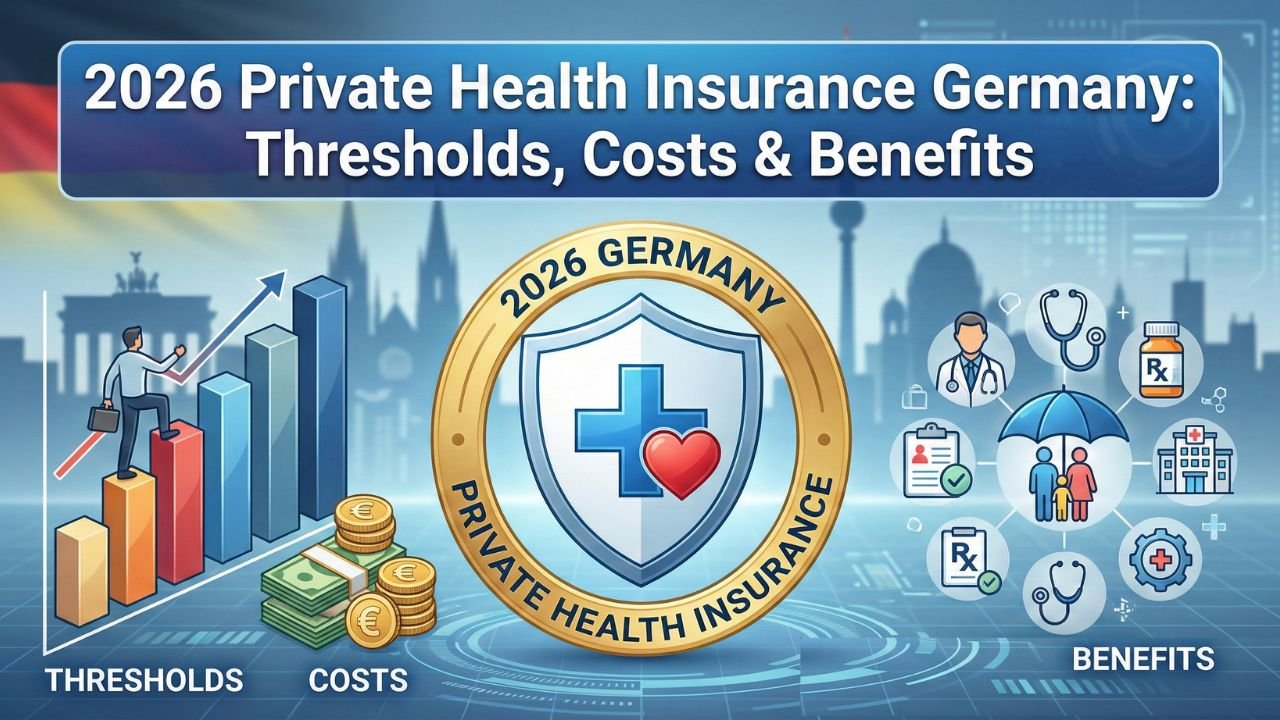
2026 Private Health Insurance Germany: Thresholds, Costs & Benefits

For high earners and expats in Germany, 2026 marks a significant shift in the healthcare landscape. With new government thresholds officially confirmed, the barrier to entering the private system has risen, while the cost of staying in the public system has hit a historic high.
In 2026, eligibility for private health insurance (PKV) in Germany depends on meeting specific income thresholds. The annual compulsory insurance limit (JAEG) will increase to €77,400. Costs are based on individual risk, and benefits generally offer more comprehensive coverage than the public system.
Here is everything you need to know about the 2026 social security values, the new income thresholds (JAEG), and what this means for your wallet.
2026 Income Thresholds
For employees, eligibility for Private Health Insurance (Private Krankenversicherung or PKV) is strictly tied to income. For 2026, these thresholds have increased by nearly 5%, meaning you must earn more than ever to leave the public system.
The Compulsory Insurance Threshold (JAEG)
- Annual: €77,400 gross
- Monthly: €6,450 gross
What this means: If your gross salary is below €77,400 in 2026, you are mandatorily insured in the public system (GKV). If you earn above this amount, you are free to switch to private health insurance or remain in the public system as a voluntary member.
The Contribution Assessment Ceiling (BBG)
- Annual: €69,750 gross
- Monthly: €5,812.50 gross
What this means: This is the maximum salary amount used to calculate your health insurance contributions. Whether you earn €70,000 or €200,000, your public health insurance contribution remains capped at this level.
Special Rule: For employees who have been privately insured continuously since December 31, 2002, a special, lower JAEG applies, which is identical to the BBG (€69,750).
Costs: Public vs. Private in 2026
The financial gap between public and private insurance is widening in 2026 due to a sharp rise in public insurance add-on costs.
Public Insurance (GKV) Costs Rising
While the general contribution rate stays at 14.6%, the average additional contribution (Zusatzbeitrag) has been officially raised to 2.9% (up from 2.5% in 2025).
- Total GKV Rate: ~17.5% of your gross income (up to the BBG).
- Max Monthly Health Cost: ~€1,017 (shared 50/50 by you and your employer).
- Nursing Care Insurance: Adds another ~3.6% to 4.2%, pushing the total monthly deduction for top earners well over €1,200.
Private Insurance (PKV) Costs
Private premiums are not based on your income. Instead, they are based on:
- Entry Age: Younger is cheaper.
- Health Status: Requires a medical check.
- Coverage: Basic vs. Premium benefits.
Typical Monthly Premiums (Estimates):
- Healthy professional (30-35 years old): €350 – €550
- Established professional (40-50 years old): €550 – €800+
- Premium plans with minimal deductibles: €800+
The “Employer Subsidy” Update
Your employer contributes 50% of your private health insurance premium, but only up to the maximum amount they would have paid if you were in the public system.
Because the public insurance costs have risen, the maximum tax-free employer subsidy for private health insurance increases in 2026:
- Max Health Subsidy: Approx. €508.59 per month (previously ~€471).
- Max Nursing Care Subsidy: Approx. €198–€244 per month (depending on the state and parental status).
The Bottom Line: If your private plan costs €600/month, your employer pays ~€300, and you pay ~€300. If your plan costs €1,200/month, your employer pays ~€508, and you pay €692.
Benefits Comparison
Why do people switch? It usually comes down to access and coverage depth.
| Feature | Public Insurance (GKV) | Private Insurance (PKV) |
| Appointments | Moderate wait times; access to all public doctors. | Faster access; preferred appointments; access to private-only clinics. |
| Hospital | Multi-bed rooms; standard duty doctor. | 1-bed or 2-bed rooms; treatment by Chief Physician (Chefarzt). |
| Dental | Basic coverage; high copays for implants/crowns. | High reimbursement (up to 90-100%) for expensive dental work. |
| Family | Free family insurance for non-working spouses/kids. | Each person pays separately. (Kids cost extra, usually ~€100-€150). |
| Global | EU coverage (EHIC). Limited/None outside EU. | Worldwide coverage often included (duration varies by tariff). |
Who Should Switch in 2026?
With the JAEG at €77,400, the “corridor” for switching has narrowed.
- Single, High Earners: Generally the biggest winners. You likely save €200–€400/month compared to the GKV maximum while getting better coverage.
- DINKs (Double Income, No Kids): Both partners can likely switch and save significantly.
- Families: If you have a non-working spouse and 2+ children, public insurance is often mathematically superior because your dependents are covered for free.
- Expats: If you plan to stay in Germany only for 3–5 years, PKV allows you to save money now without worrying about rising premiums in old age.
A Warning on the “Trap”
If you are currently earning between €69,750 (BBG) and €77,400 (JAEG), you are in the “squeezed middle.” You pay the maximum contributions to the public system but are not eligible to leave it.
Disclaimer: This post is for informational purposes only and does not constitute financial or insurance advice. Regulations and individual tariffs are subject to change.